Fixed CO2 Systems in the Maritime Sector: What Do International Standards Require?
Fixed CO2 systems are the primary defense against onboard fires, but their complexity demands absolute precision. Discover what the leading international and national standards — such as IMO (SOLAS), NFPA 12, NORMAM-01, and Classification Societies — require to ensure your vessel's compliance and safety
A fire on the high seas is, without a doubt, any crew's worst nightmare. In confined spaces, with vast amounts of fuel and equipment operating at high temperatures — such as engine rooms —, a fire can spread in a matter of seconds.
It is exactly for these critical scenarios that the Fixed CO2 (Carbon Dioxide) System exists. It acts as the vessel's last and most robust line of defense, designed to quickly smother flames by reducing the oxygen levels in the environment.
However, the same effectiveness that extinguishes the fire makes CO2 extremely dangerous (and lethal) to humans. Therefore, the installation and maintenance of these systems are not just an engineering issue, but a matter of strict legal compliance.
If you operate, design, or manage the maintenance of vessels, you need to know what the four main regulatory frameworks say about the subject.
The Maze of Standards: Who Sets the Rules?
The regulation of offshore fire fighting systems is built in layers to ensure that no failure goes unnoticed.
1. IMO (SOLAS and FSS Code): The Global Law
The International Maritime Organization (IMO) sets the rules of the game for global navigation.
- Mandatory Requirement: Chapter II-2 of the SOLAS convention requires the presence of fixed systems in category A machinery spaces.
- Critical Performance: The FSS (Fire Safety Systems) Code goes further and dictates performance: the system must be capable of discharging 85% of its entire gas capacity within 2 minutes into the engine room.
- Life Safety: Due to the risk of asphyxiation, the IMO mandates the installation of visual and audible pre-discharge alarms, in addition to requiring a two-step activation (two distinct valves) to prevent accidental discharges.
2. NFPA 12: The Engineering Manual
While the IMO dictates what must be done, NFPA 12 (National Fire Protection Association) explains how to do it. It is the "bible" for fire protection engineers.
- It defines the rigorous structural calculations for piping, pressure loss, and the positioning of discharge nozzles.
- It establishes the interlocking rules: upon activating the CO2, the system must automatically cut off local ventilation, close the dampers, and shut down the fuel pumps. Without this, the gas would escape and the fire would continue to be fed.
3. NORMAM-01 (Brazilian Navy): The House Rule
For vessels operating in Brazilian Jurisdictional Waters (AJB), the Directorate of Ports and Coasts (DPC) applies NORMAM-01.
- It incorporates the SOLAS requirements but adapts volumes and prerequisites for vessels operating in coastal or inland navigation (non-SOLAS).
- The standard strongly emphasizes training. The crew must have a deep understanding of the system's lockout/tagout procedures during preventive maintenance, avoiding tragedies due to improper activation.
4. Classification Societies: Rigorous Enforcement
Institutions like DNV, ABS, and Lloyd’s Register are the eyes of the law on board. They unify the requirements of the IMO and NFPA and enforce them in practice.
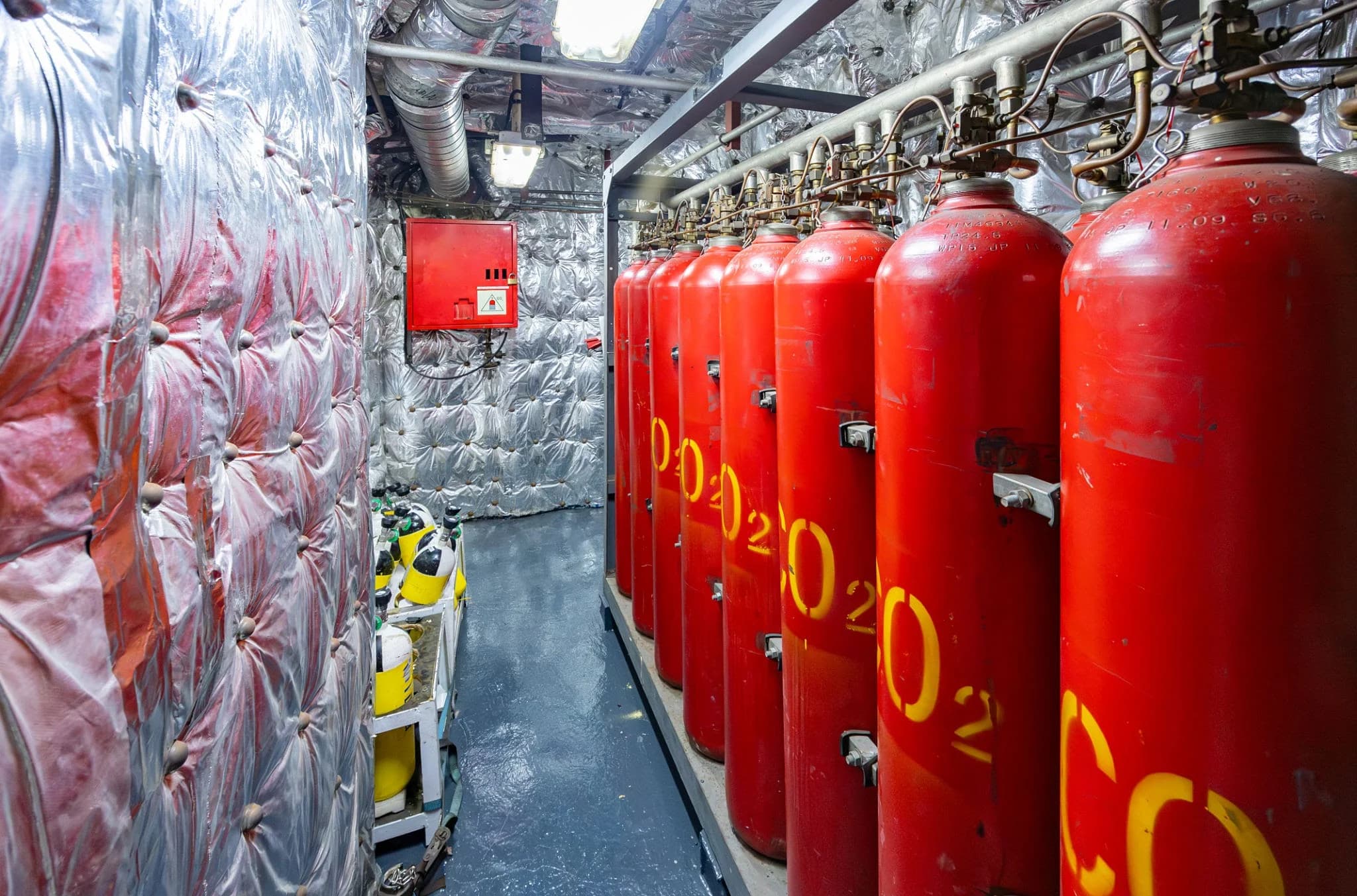
- Cylinder Room: Classification societies require the CO2 storage room to be completely isolated from the area it protects, with doors opening outward (to the open deck) and independent exhaust ventilation — since CO2 is heavier than air and accumulates on the floor in the event of a leak.
- It is the class surveyors who approve the project diagrams and oversee the blow-through tests before issuing the vessel's operation certificate.
Maintenance: The Compliance That Saves Lives
Having the system installed is just the first step. The constant vibration, salinity, and passage of time on a ship are the silent enemies of any safety equipment.
Stuck valves, loss of pressure in the cylinders, and obstructed piping can turn multi-million dollar equipment into useless dead weight exactly when the crew needs it most.
Is your vessel 100% compliant with the requirements of the IMO and Classification Societies?
Do not leave the safety of your crew and your asset to chance. [Your Company Name] specializes in the inspection, certification, and maintenance of Fixed CO2 Systems, ensuring that your vessel meets all national and international standards.
Speak with one of our engineers today and schedule your system's inspection!
Does your vessel need to be 100% compliant?
Request a no-obligation proposal. Our technical team will return within 24 business hours.
Request Proposal